


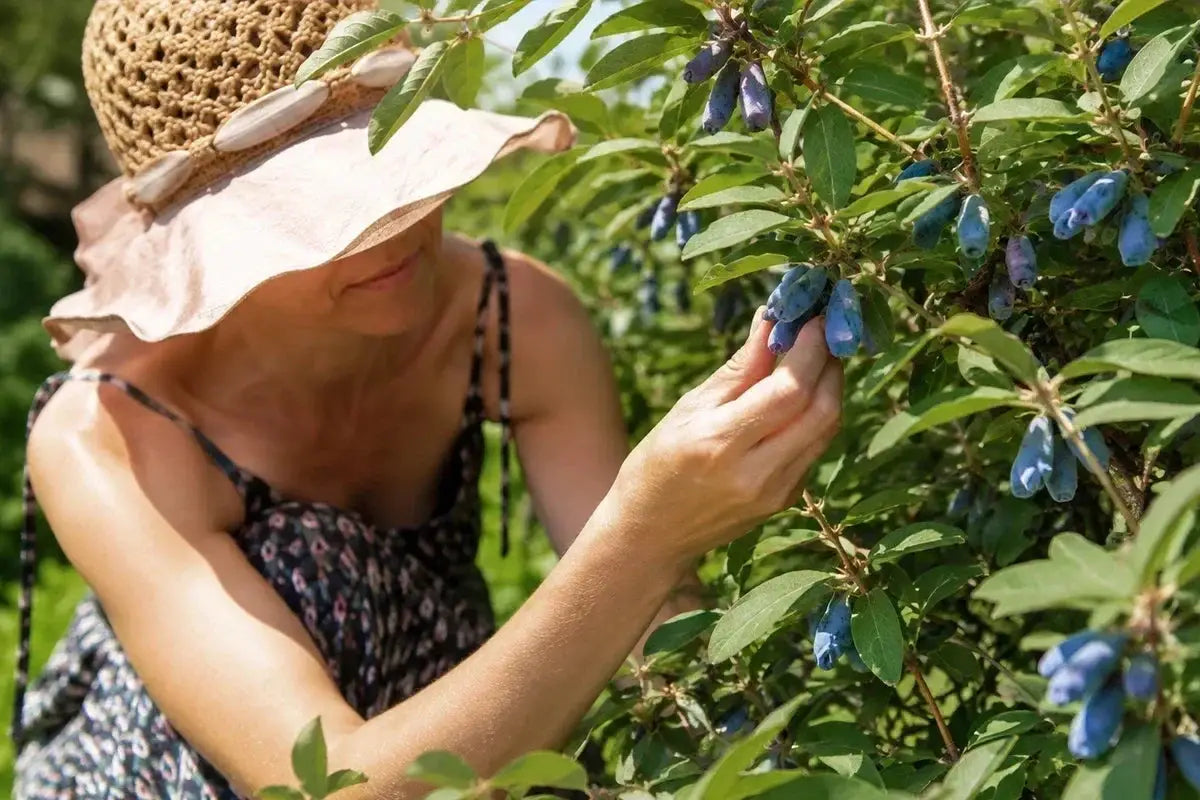
Honeysuckle flowers and berries can both be edible, but not from every species: Japanese honeysuckle (Lonicera japonica) is known for edible flowers and nectar, while blue honeysuckle (Lonicera caerulea) is grown for edible berries.
Now imagine the plant is right in front of you: a fragrant vine curling over a fence, pale flowers within reach, or a carton of dark-blue haskap berries at a market. You can see why the common name is tempting – everything is described as “honeysuckle” – but the name alone does not tell you which parts are edible. The answer depends on both the species and the part of the plant. Once you know which Lonicera you are looking at, the difference between a culinary flower, an edible berry, and an ornamental fruit becomes much easier to navigate.

Why the Name “Honeysuckle” Can Be Misleading
Honeysuckle is not one plant. It is a common name used for species in the genus Lonicera, a large group of vines and shrubs found across the Northern Hemisphere. Penn State Extension notes that the genus includes around 180 species. That is why advice based only on the word “honeysuckle” can be misleading.
Two plants can share the same everyday name while offering very different food uses. Lonicera japonica is a fragrant climbing vine. Lonicera caerulea is a fruiting shrub better known as haskap or honeyberry. Other ornamental honeysuckles may grow attractive berries that are not considered food for people.
If you want another example of why names and plant parts deserve separate attention, our interesting article Pleurisy Root vs Butterfly Weed shows how one species can carry two very different everyday labels.
Are Honeysuckle Flowers Edible?
Yes, some honeysuckle flowers have a documented food use. For Japanese honeysuckle, Lonicera japonica, the NC State Extension Plant Toolbox states that nectar can be drawn from the flowers and that the flowers are used as an ingredient in some Chinese dishes.
The plant is easy to remember for its fragrance and for flowers that open white and age toward cream or yellow. Those traits can help you recognize the plant, but they are not enough to decide whether it is edible. A white-to-yellow flower on a vine is still a visual clue, not a botanical confirmation.
Japanese honeysuckle flowers have practical food benefits that go beyond their fragrance: edible nectar, use as a floral ingredient, and a long documented tradition of food use. A 2025 PLOS ONE study comparing buds with open flowers of Lonicera japonica found clear differences in their compound profiles, while a systematic review of Lonicerae japonicae flos reports groups such as organic acids, flavonoids, iridoids, and volatile oils. In simple terms, the flower brings aroma, culinary versatility, and a well-studied botanical composition.Laboratory studies have linked compounds such as chlorogenic acid and flavonoids to the flowers’ antioxidant activity.
What does that mean in a daily wellness routine? Honeysuckle flowers bring a distinctive mix of plant compounds to the table. They contain chlorogenic acid, flavonoids, iridoids, and other plant compounds, giving the flowers a varied source of phytonutrients and natural antioxidant compounds. Because this profile comes from the flower rather than the fruit, honeysuckle can also bring greater botanical diversity to a routine built mostly around roots, berries, leaves, or mushrooms.
That distinction becomes especially useful when you move from a plant guide to a finished herbal product. On our Honeysuckle Tincture page, we identify the herb as Lonicera japonica, so you can see exactly which honeysuckle stands behind the common name.


Are Honeysuckle Berries Edible?
Some honeysuckle berries are genuine food fruits, but that status belongs to particular species. Blue honeysuckle, Lonicera caerulea, is the clearest example. The Missouri Botanical Garden lists its fruit as edible and notes that the berries can be eaten fresh or used in pastries, jams, jellies, juices, sauces, and other foods.
Haskap berries are typically deep blue with reddish-purple flesh and a blueberry-like, often sweet-tart flavor. Their practical strengths are easy to notice in the kitchen: vivid natural color, a distinctive berry taste, and a composition that includes anthocyanins and other phenolic compounds. In a 2017 study of 30 cultivars and genotypes, researchers identified iridoids, anthocyanins, flavonols, flavones, and several phenolic acids.
Haskap berries offer a different set of nutritional advantages. Their deep blue-purple color comes largely from anthocyanins. In many varieties, cyanidin-3-glucoside is the main anthocyanin researchers find. They also provide vitamin C alongside phenolic compounds and iridoids, making the whole fruit a varied source of berry phytonutrients. For an everyday diet, that translates into three straightforward benefits: anthocyanin-rich plant compounds, additional vitamin C, and greater polyphenol variety from a food that can be eaten fresh or used in familiar berry recipes.
The contrast is important. NC State lists the fruits of Lonicera japonica as the poisonous part of that plant and notes toxicity when large quantities are eaten. Penn State likewise describes the berries of species such as Lonicera dioica and Lonicera sempervirens as toxic to humans even though birds consume them. Color, sweetness, fragrance, or wildlife interest therefore cannot replace species-level identification.
If you want to go deeper into the composition of dark fruits, our Maqui vs Acai vs Elderberry guide compares three berries through their anthocyanin profiles and food context.

Honeysuckle Flowers vs Berries: Species Snapshot
|
Common name |
Botanical name |
Food-use part |
What to know |
|---|---|---|---|
|
Japanese honeysuckle |
Lonicera japonica |
Flowers and nectar |
NC State documents flower and nectar use; the fruit is listed as a poisonous plant part. |
|
Blue honeysuckle / haskap |
Lonicera caerulea |
Berries |
Missouri Botanical Garden lists the fruit as edible and describes common culinary uses. |
|
Limber / wild honeysuckle |
Lonicera dioica |
No berry food use |
Penn State notes that birds eat the fruit, while the berries are toxic to humans. |
How to Check Honeysuckle Before Eating It
A quick check works better than guessing from berry color or flower scent. Use this sequence before treating any wild or garden honeysuckle as food.
What you need: a nursery tag or reliable plant record, an Extension or botanical-garden source, and about 5–10 minutes.
1. Find the botanical name – Write down the full Lonicera name, including the species. If it is a cultivated garden plant, record the cultivar when available.
2. Match the exact plant part – Check the guidance for the flower, nectar, berry, leaf, or other part you plan to use. Information about one part does not automatically apply to the rest of the plant.
3. Verify it with an authoritative source – Confirm the species in an Extension resource, botanical-garden database, or similarly reliable reference. If sources conflict or the identification does not match cleanly, do not eat the plant.
4. Check where the plant grew – Skip roadside plants, ornamental plantings with unknown spray histories, and material collected from contaminated or treated areas. Correct species identification does not answer the question of how the plant was managed.
5. Stop when the identity is uncertain – If you cannot confirm both the species and the edible plant part, leave the plant unharvested and choose a verified food source instead.
Once the species, plant part, and growing history all line up, you have a much stronger basis for deciding whether a honeysuckle belongs in the kitchen.
From Wild Plant to Supplement: Why the Label Still Matters
If you are looking at a plant outdoors, identification comes first. If you are looking at a supplement, the label should already tell you the botanical name and the plant part used in the formula.
On a supplement label, look for three details together: the common name, the Latin name, and the plant part. That tells you far more than the word “honeysuckle” on the front. In this multi-herb tincture formula, we list Honeysuckle (Lonicera japonica) Dried Flowers, so the ingredient itself tells you both the species and the material used.
That plant-part line is worth reading closely. Root, bark, flower, fruit, and leaf describe different raw materials, so they make product-to-product comparisons much clearer.
Conclusion
With honeysuckle, the useful shortcut is simple: read past the common name. Japanese honeysuckle flowers and blue honeysuckle berries belong to different food traditions, with different flavors, uses, and botanical identities.
Keep the Latin name close when you shop, garden, or read an ingredient label. It turns “honeysuckle” from a broad category into a specific plant-and makes it much easier to choose the right part for the right use.
FAQ about Honeysuckle
Do honeyberries taste like honey?
Not necessarily. The name honeyberry comes from the honeysuckle family, not from a guaranteed honey-like flavor. Depending on the cultivar, the taste can lean blueberry-like, sweet-tart, or tangy.
Are honeysuckle and elderberry the same plant?
No. Honeysuckles belong to the genus Lonicera, while elderberries belong to Sambucus. Similar-looking berries or shared herbal contexts do not make the plants botanically interchangeable.
When are haskap berries harvested?
Haskap is an early-season fruit in many cool-climate regions. Timing varies by cultivar and weather, and blue color can appear before full ripeness, so harvest guidance for the specific cultivar is more useful than color alone.
Is Japanese honeysuckle invasive in the United States?
Lonicera japonica is considered invasive in many parts of the United States. NC State classifies it as highly invasive in North Carolina, so local Extension guidance is useful if the plant is growing in your yard.
Can blue honeysuckle grow in warm climates?
It generally performs best in colder regions. Missouri Botanical Garden places Lonicera caerulea in USDA Zones 2–7 and notes that areas south of Zone 7 may not provide enough winter chilling for strong fruit production.
Glossary
-
Botanical name: A standardized scientific name, usually written as genus plus species, used to identify a plant more precisely than a common name.
-
Lonicera: The botanical genus that contains honeysuckles.
-
Species: A specific botanical unit within a genus, such as Lonicera japonica or Lonicera caerulea.
-
Cultivar: A cultivated plant selection with defined horticultural characteristics.
-
Plant part: The specific material used or discussed, such as flower, fruit, leaf, root, or bark.
-
Haskap: A common name used for edible-fruited forms of Lonicera caerulea; honeyberry is another common name.
-
Nectar: A sugar-containing liquid produced by flowers and visited by pollinators.
Share:
Wild Geranium vs Rose Geranium: Are They the Same Plant?
Eleuthero vs Ashwagandha: Key Differences